Architecting workspace for Florence Classic Art Academy
SaaS
Automation
Education
Dashboards
CMS
The development chronicle of how we built a custom internal operating system for Florence Classic Art Academy—unifying schedules, grade ledgers, and document flows into a coordinated split-role canvas for students, faculty, and administrative staff.
About the project
In traditional academic environments, administrative overhead is the silent killer of productivity. When an international academy relies on separate tools for tracking class hours, sharing high-resolution art portfolios, sending study materials, and managing student payments, information gaps are inevitable.
Florence Classic Art Academy needed to transition from fragmented legacy management into a cohesive, modern digital ecosystem. They required a centralized hub capable of handling the entire lifecycle of both local and international students, managing faculty workloads, and streamlining daily campus administration.
The core objective was to design and engineer a private, role-based CRM that coordinates real-time scheduling, communication, and attendance tracking without overwhelming non-technical users.

Challenge
Building an educational workspace introduces a unique user-experience challenge: you must serve three completely different demographics—students seeking clarity, professors managing studio hours, and administrators handling strict compliance metrics—all within the same underlying database.
For this academy, the core execution hurdles required deep operational logic:
Structure a triple-interface system separating daily student updates, professor tools, and master admin variables.
Engineer an interactive, automated academic calendar that handles overlapping studio slots and rolling term changes.
Build a reliable, low-friction attendance tracking module that fits into a physical studio workflow.
Deploy a secure, integrated document and messenger framework to eliminate chaotic third-party chat loops.
This project represents a classic workflow optimization problem: how to consolidate disparate data streams and manual record-keeping into a single, beautiful, and highly responsive web product.
Our Approach
We treated the academy CRM not as a rigid corporate tracker, but as a living campus command center, designing every layout around daily high-frequency workflows like checking schedules or updating attendance on a tablet.
From day one, our team assumed complete lifecycle ownership of the system build—driving deep user persona mapping, interactive data-grid layouts, messaging architecture, and full-stack component engineering.
Working directly with academic coordinators and international students, we mapped real-world studio behaviors into clean layout layers. This ensured that a professor can log an entire studio's attendance in three taps, and an administrator can audit a student’s documentation folder instantly without wading through nested folders.
Here is how we executed the academic transformation:
Engineering the Triple-Interface Matrix
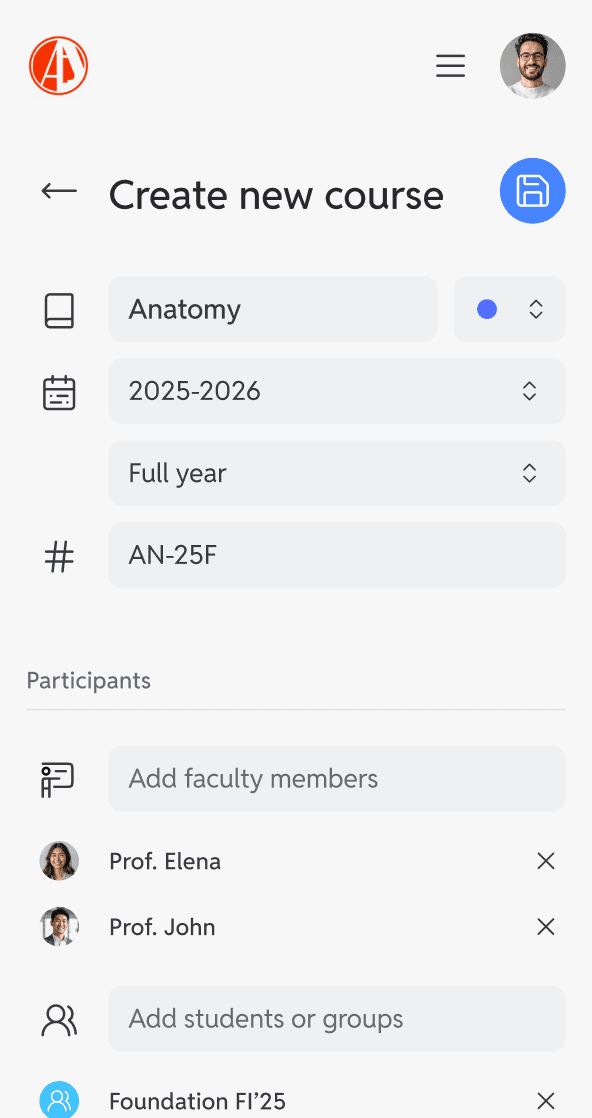
We mapped out distinct operational profiles for the system. We engineered a unified app that adapts completely based on user privileges: the Student Portal prioritizes assignments and calendar feeds; the Professor Dashboard focuses on class management and attendance; while the Master Admin Panel surfaces staff contracts, billing records, and global configuration toggles.
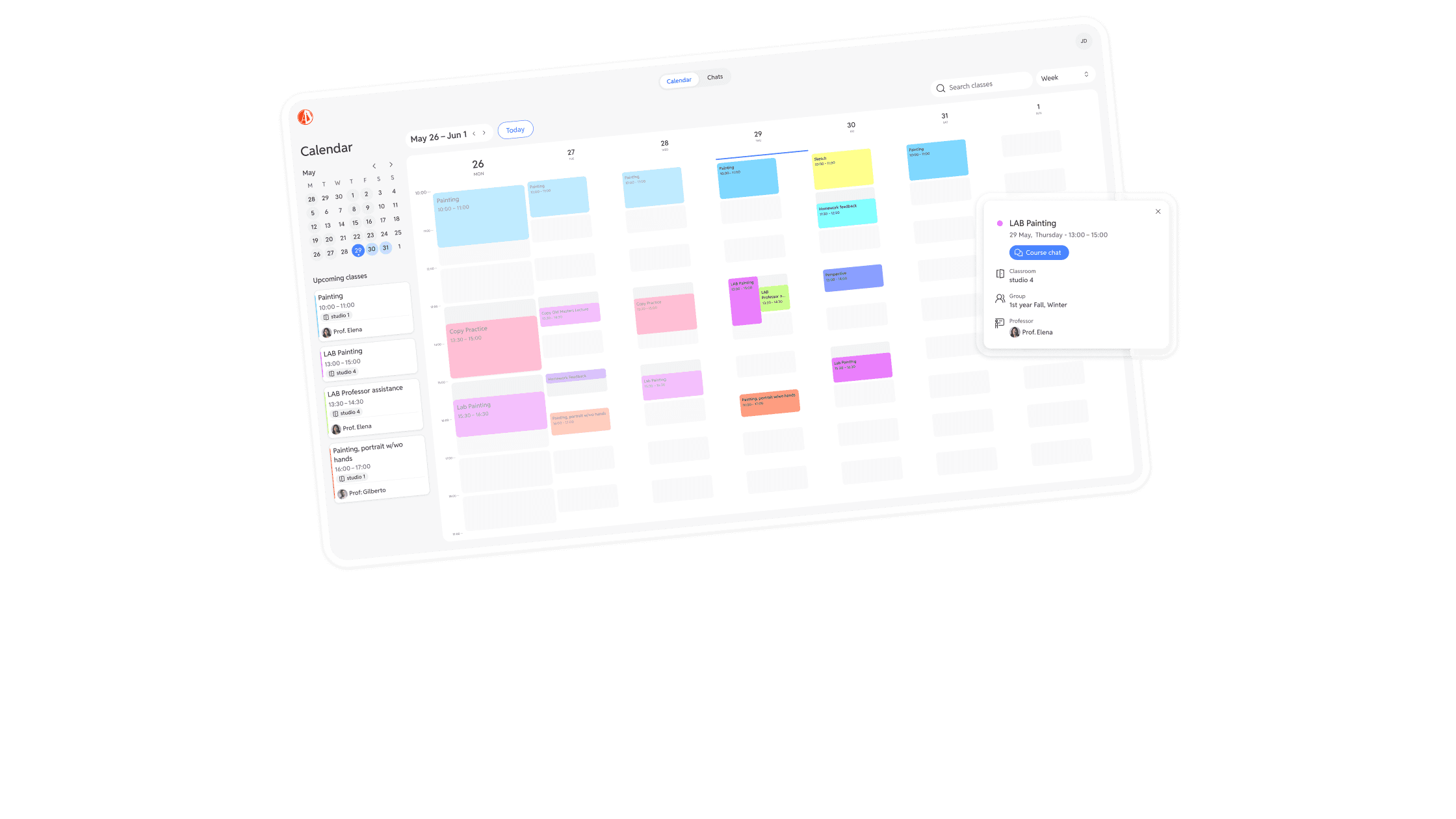
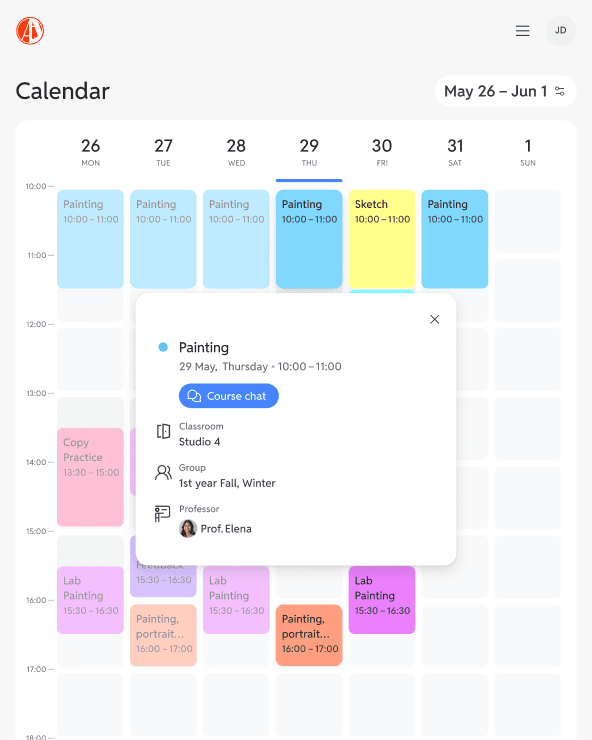
Building an Interactive Campus Calendar
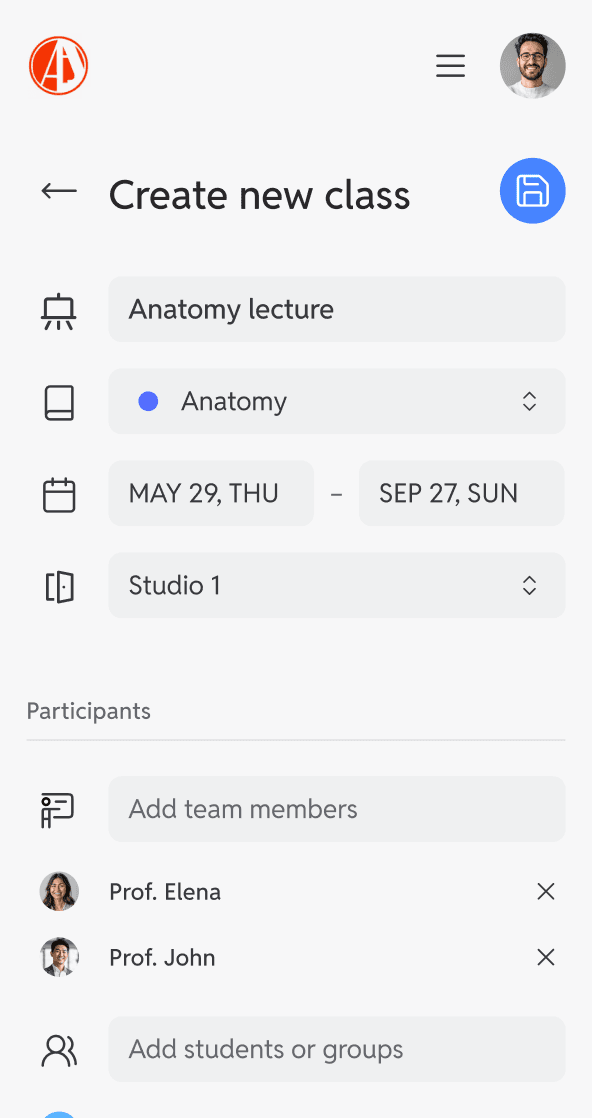
We constructed a visual scheduling board that updates dynamically. Admins can plot out lectures, studio workshops, and critiques, while the system automatically surfaces tailored, color-coded daily grids to individual student and teacher feeds, eliminating timezone and room conflicts.
Designing the Live Attendance & Grading Deck
We built an ultra-clean tracking interface optimized for mobile and desktop screens. Faculty members can toggle student attendance statuses instantly, log justifications for absences, and link daily participation metrics straight to the core student archive for automated report generation.
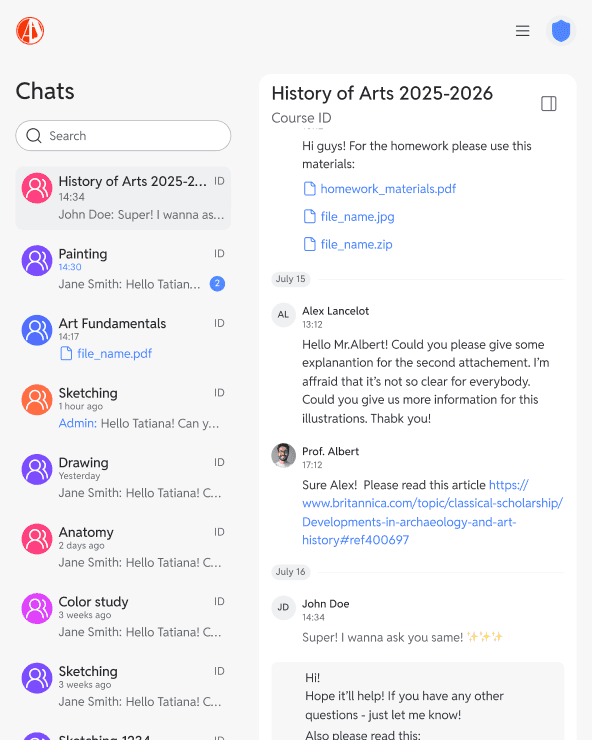
Unifying Communications & Document Control
To eliminate scattered email threads, we engineered a secure, built-in messaging module and file repository. Students and faculty can share resources, submit assignments, and message each other directly within their dashboard canvas, keeping all academic assets under one roof.
Every component row, calendar block, and message modal was engineered to enforce three strict parameters: operational simplicity, absolute data clarity, and split-second mobile responsiveness.
Key Features
Split-Role User Environments
A dynamic application core that instantly restructures the UI layout, menus, and data privileges based on whether an admin, professor, or student logs in.
Interactive Academic Timelines
A high-performance calendar engine that displays classes, studio deadlines, and institutional events with smart filtering by course or year.
Frictionless Attendance Ledger
An agile, grid-style roll-call sheet allowing faculty to log daily attendance, track tardiness, and submit session summaries within seconds.
Centralized Student & Staff Directories
Comprehensive data hubs storing enrollment files, contact lists, academic histories, and visa compliance statuses in structured, searchable cards.
Built-In Messenger Core
A secure, real-time chat environment featuring direct messaging, course-wide announcement channels, and instant attachment support.
Secure Cloud Document Vault
An organized file-sharing module allowing students to download syllabi and upload digital assignments directly to specific course folders.
Unified Visual Token Ledger
A clean, high-contrast design system that leverages soft color-coded states to differentiate classes, attendance markings, and system alerts instantly.
Lightweight Profile Settings
Frictionless configuration sheets where international students can manage language preferences, update contact details, and track tuition statuses on the fly.
Tech Stack
Frontend Architecture: React, TypeScript
Backend Core: Node.js, Modular REST/GraphQL API framework
Database & Synchronization: PostgreSQL for transactional records, WebSockets for live chat streaming
Design Systems: Figma
Results
Designed, developed, and successfully launched a fully custom academic CRM tailored for an international student body.
Replaced five disconnected tools (spreadsheets, chat apps, cloud storage, calendars) with a single, unified campus workspace.
Slashed administrative overhead by automating calendar distribution and syncing attendance logs directly with student records.
Drastically reduced communication friction, ensuring students and faculty stay contextually connected within their dashboard.
Why This Matters
For prestigious educational institutions, boutique academies, and training networks, a unified CRM is a baseline requirement for sustainable scaling. When student data, schedules, and communications live in siloed systems, administrative friction inevitably leads to manual errors, lost documents, and a degraded student experience.
A focused, role-based full-stack architecture proves that:
Integrating multi-tenant portals into a single layout completely transforms slow campus habits into instant, automated assets.
Wrapping heavy scheduling and data grids inside clean, scannable interfaces ensures usability for all age groups and skill levels.
Reclaiming complete control over your operational stack eliminates software licensing bloat and builds an institutional asset that commands long-term trust.
Instead of adapting their workflow to rigid, generic school-management templates, Florence Classic Art Academy deployed an elite digital ecosystem built specifically around the way they teach.



Astana, KZ
Turning complex ideas
into high-performance products
©
2026
AlexFrontEnd
A. Bobykin SP · TIN 821019050222
NP 113, 23 Bukhar Zhyrau St, Astana, Kazakhstan